
What Israel’s greatest king teaches leaders about trust, failure, repentance, mercy, and legacy
By Gerald J. Leonard
The greatest leadership stories rarely begin with perfection.
They begin with calling.
A shepherd is overlooked in the field.
A young man faces a giant.
A fugitive refuses to kill the king who is hunting him.
A warrior becomes king.
A worshiper writes songs that still give language to grief, praise, fear, repentance, and hope.
That is the story of David.
But David’s life cannot be understood through Goliath alone.
To understand David, we must also sit with Bathsheba, Uriah, Nathan, Mephibosheth, Absalom, Psalm 40, Psalm 51, and Solomon.
David was not a man after God’s heart because he never failed.
David was a man after God’s heart because his heart kept returning to God.
That distinction matters enormously for leaders today.
Many leaders know how to win publicly. Fewer know how to remain spiritually grounded privately. Many know how to perform under pressure. Fewer know how to repent when pressure exposes what is hidden. Many know how to build a platform, a company, a ministry, or a reputation. Fewer know how to pass on a way of walking with God.
David’s leadership secret was not perfection.
It was faithful return.
The Returnable Heart Beneath the Crown
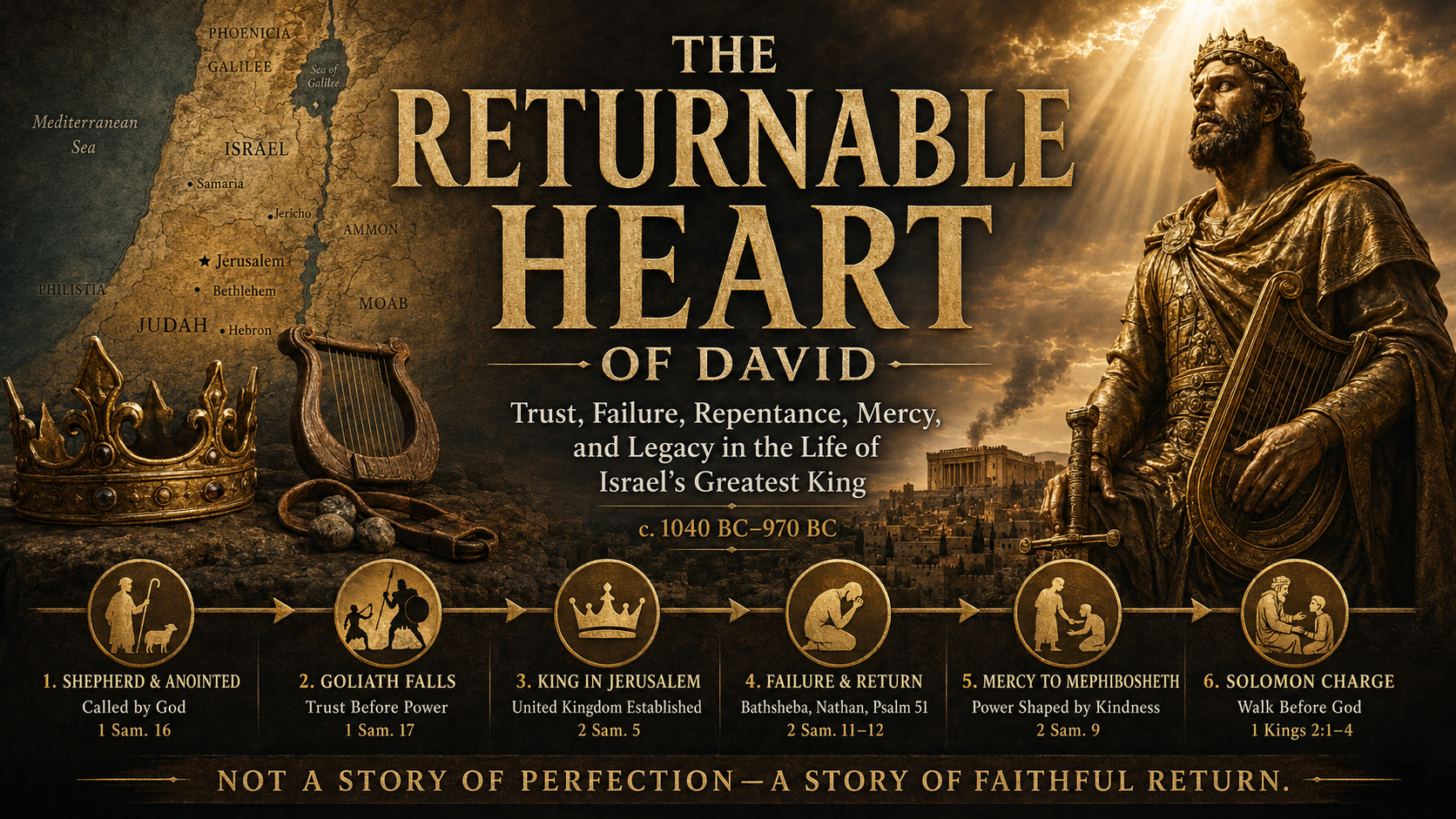
The slide that inspired this study summarizes David’s life around three powerful biblical anchors:
Psalm 40:1–17 — David trusted God, waited on God, praised God, and cried out for mercy.
Acts 13:22 — David is described as a man after God’s own heart.
1 Kings 2:1–4 — David instructs Solomon to walk before God, keep His commands, and lead faithfully.
Together, these passages create a leadership portrait that is both inspiring and sobering.
David trusted God alone.
David knew God would be faithful.
David was not perfect.
David learned to turn back to God again and again.
David instructed the next generation to walk before the Lord.
That is the heartbeat of faithful leadership.
Not flawless performance.
Not polished image.
Not constant victory.
Not unchecked power.
A returnable heart.
What Was
David looked like the ideal king.
He had courage.
He had charisma.
He had military strength.
He had poetic depth.
He had musical gifting.
He had public influence.
He had covenant promise.
He had national authority.
Under David, Israel experienced consolidation, military victories, Jerusalem’s rise as the royal city, and a kingdom identity that would shape Israel’s future imagination.
But beneath the crown was a deeper truth:
David’s greatness was never merely political.
It was spiritual.
Psalm 40 reveals the inner life behind the public leader. David remembers being lifted from the pit. He speaks of God steadying his steps. He celebrates a new song. He declares God’s faithfulness publicly. He confesses that his troubles and sins are too many to count. He ends not in self-sufficiency, but dependence: God is his helper and savior.
This is the first major leadership insight:
David’s authority was strongest when his dependence was deepest.
The leader before the throne was formed in the field, in the cave, in worship, in danger, in waiting, and in prayer.
David’s public courage was built on private dependence.
What Could Be
David’s story invites leaders into a different model.
What is:
- performance without formation
- visibility without vulnerability
- success without watchfulness
- influence without accountability
- repentance replaced by reputation management
- legacy reduced to achievement
What could be:
- trust before authority
- worship beneath responsibility
- courage joined to humility
- correction received as grace
- repentance before image repair
- power used for mercy
- obedience passed to the next generation
This is why David still speaks to Christian executives, ministry leaders, entrepreneurs, fathers, mothers, teachers, and serious students of Scripture.
David’s life is not merely ancient history.
It is diagnostic literature.
It helps us ask: What is happening beneath the visible success?
Trust Before the Throne
Psalm 40 begins with waiting.
David says he waited patiently for the Lord.
That line is easy to read quickly and hard to live faithfully.
Waiting is not passive when it is rooted in trust. David does not say, “I solved my own way out of the pit.” He says God turned to him, heard him, lifted him, steadied him, and gave him a new song.
This is not the language of ego.
It is the language of dependence.
That matters because many leaders want authority before formation. They want the throne before the trust. They want the Goliath moment before the hidden obedience that prepares them for it.
David teaches the opposite.
Before David ruled Israel, he learned to trust God in obscurity.
Before he carried a crown, he carried responsibility in the field.
Before he led a nation, he learned to worship when no crowd was watching.
That is the first movement of faithful return leadership:
Private dependence prepares public authority.
Leaders who do not learn dependence in hidden places can become dangerous when they receive visible power.
A Man After God’s Heart Was Still a Man Who Needed Mercy
Acts 13:22 gives one of the most famous summaries of David’s life: God found David to be a man after His own heart.
But we must be careful.
That phrase does not mean David was morally flawless.
The biblical story itself will not allow that interpretation. David’s life includes catastrophic failure, abuse of power, deception, violence, family breakdown, grief, and painful consequences.
So what does it mean?
It means David’s heart was fundamentally Godward.
He could be confronted.
He could be corrected.
He could be broken.
He could repent.
He could worship.
He could return.
That is the difference between a polished image and a responsive heart.
A leader after God’s heart is not a leader who never needs correction. It is a leader who does not harden when correction comes.
David’s heart was not flawless.
But it was returnable.
The Promise Beneath the Performance
David’s life must also be read in light of 2 Samuel 7.
God makes covenant promises to David. His house, kingdom, and throne become part of the great biblical movement that points forward to the Messiah.
That means David’s life is not merely a leadership lesson. It is part of God’s redemptive story.
John Woodhouse’s kingdom framework is helpful here. David’s reign matters because it reveals God’s purpose, but David’s failures matter because they reveal the limits of human kingship. David is great, but not ultimate. David is chosen, but still needy. David points beyond himself.
This gives us the deeper theological insight:
David’s story is held together by God’s faithfulness, not David’s perfection.
God calls David.
God delivers David.
God promises David.
God corrects David.
God forgives David.
God disciplines David.
God continues His purpose through David’s line.
That is why David’s life gives hope without becoming sentimental.
God does not need flawless people to fulfill His purposes.
But He does form people who are willing to return.
Success Without Humility Becomes Dangerous
David’s greatest failure does not happen when he is young, overlooked, or hunted.
It happens when he is established.
That should sober every leader.
David does not fall when he is facing Goliath.
He does not fall when Saul is chasing him.
He does not fall when he is living under pressure in the wilderness.
His most devastating collapse comes when he has power.
The story of Bathsheba and Uriah is not a minor mistake. It is a catastrophic abuse of authority. David uses power to take, hide, manipulate, and destroy.
This is one of Scripture’s clearest warnings about leadership drift.
Power does not remove temptation.
Power can magnify unattended weakness.
Success can reduce feedback.
Authority can expand permission.
Isolation can dull discernment.
Image protection can become more tempting than truth.
In modern leadership language:
- platform can hide private erosion
- achievement can mask spiritual drift
- influence can weaken accountability
- pressure can rationalize compromise
- power can turn desire into damage
This is the David story we must not skip.
If we only teach David and Goliath, we may inspire courage.
But if we ignore David and Bathsheba, we fail to warn leaders about the danger of success without humility.
Every David Needs a Nathan
Nathan’s confrontation is one of the most important leadership moments in Scripture.
David needed a truth-teller.
That sentence alone is a leadership principle.
No leader becomes too gifted for correction.
No leader becomes too successful for accountability.
No leader becomes too spiritual to need someone who can speak the word of God into hidden places.
Nathan interrupted David’s concealment.
Without Nathan, David’s sin could have hardened.
Without Nathan, David’s power could have protected his deception.
Without Nathan, David’s heart could have drifted further from God.
This is why faithful leaders need what I call a Nathan circle.
A Nathan circle is not a group of admirers.
It is not a group that only affirms your talent.
It is not a group that protects your brand at the expense of truth.
A Nathan circle is made of people who love God, love you, and love truth enough to confront drift before it becomes destruction.
Every David needs a Nathan before the kingdom pays the price.
Repentance Is Not Reputation Repair
David’s repentance is one of the clearest marks of his returnable heart.
He does not merely manage the crisis.
He does not only protect the throne.
He does not simply craft a public statement.
He turns toward God.
Psalm 51 gives language to this kind of repentance, but Psalm 40 also shows the same pattern of dependence and need. David can praise God’s deliverance and still admit that his sins and troubles are overwhelming.
That honesty matters.
Many leaders confuse apology with repentance.
An apology may be strategic.
Repentance is spiritual.
An apology may protect reputation.
Repentance returns to God.
An apology may focus on consequences.
Repentance focuses on the condition of the heart.
David’s repentance does not erase the damage. It does not remove every consequence. It does not make his failure small.
But it does reveal that his heart is still responsive to God.
That is why repentance is central to faithful leadership.
The question is not only, “Will I ever fail?”
The deeper question is:
When I fail, will I hide or return?
Power Under God Becomes Mercy
David’s story is not only failure and repentance.
It is also mercy.
The story of Mephibosheth in 2 Samuel 9 reveals a different side of David’s leadership. David remembers his covenant with Jonathan and shows kindness to someone vulnerable, politically inconvenient, and easily forgotten.
This is power under God.
David could have erased Mephibosheth.
He could have ignored him.
He could have treated him as a threat.
Instead, he restored dignity.
That story matters because it shows what authority can become when shaped by covenant mercy.
Power under God does not merely protect itself.
It restores others.
This is one of the clearest leadership contrasts in David’s life.
With Bathsheba and Uriah, power becomes danger.
With Mephibosheth, power becomes mercy.
That contrast is still relevant.
The test of leadership is not only what we build.
It is how we treat people who cannot advance our agenda, strengthen our platform, or protect our image.
Godly authority remembers the vulnerable.
Worship as the Inner Operating System
David’s music was not decorative.
It was formative.
David’s psalms reveal the inner operating system of a leader who processed life with God. He lamented. He praised. He confessed. He thanked. He waited. He asked for rescue. He remembered deliverance.
This is one reason David’s life speaks so deeply to modern leaders.
Leadership pressure produces emotional weight.
Responsibility creates fatigue.
Success brings temptation.
Failure brings shame.
Conflict brings fear.
Legacy brings burden.
David teaches us that leaders need more than strategy.
They need worship.
Worship is not escape from leadership responsibility. It is one of the ways the heart is formed to carry responsibility without being consumed by it.
Private worship shapes public resilience.
Achievement Builds a Record; Obedience Builds a Legacy
The image ends with 1 Kings 2:1–4, and that is significant.
David is near death. Solomon is about to inherit the throne. David’s final instruction is not merely political. It is covenantal.
He tells Solomon to be strong.
To observe God’s requirements.
To follow God’s ways.
To keep God’s commands.
To walk faithfully with all his heart and soul.
David does not simply tell Solomon how to rule.
He tells him how to walk.
That may be David’s final leadership lesson.
Legacy is not only what people remember about you. It is what continues faithfully after you.
David had victories.
David had influence.
David had songs.
David had failures.
David had grief.
David had promises.
But at the end, he wanted Solomon to understand the central issue:
Walk before God.
That is the difference between achievement and legacy.
Achievement builds a record.
Obedience builds a legacy.
The Neuroscience of Leadership Drift
One reason David’s story feels so modern is that it aligns with what we observe in leadership behavior under pressure.
When leaders experience success, pressure, or threat, several things can happen.
Feedback decreases.
People become less willing to speak honestly.
Permission expands.
The leader begins to believe the rules are flexible.
Identity becomes fragile.
Failure feels like a threat to the self, not merely a mistake to correct.
Image protection increases.
The leader works harder to preserve perception than to seek truth.
That is how drift becomes dangerous.
David’s life interrupts this cycle.
Nathan restores truth.
Repentance restores humility.
Worship restores dependence.
Mephibosheth restores mercy.
Solomon restores legacy.
This is the productivity and leadership insight:
Sustainable leadership is not only about managing time. It is about managing the heart under pressure.
A leader can be productive and still be spiritually drifting.
A leader can be efficient and still be unformed.
A leader can scale results and still lose the sensitivity that made the assignment sacred.
David warns us that success without humility can become a throne of danger.
But David also shows us that return is possible.
The Leadership Framework of the Returnable Heart
David’s life can be understood through seven movements of faithful return.
1. Trust Before Visibility
David’s pattern: He trusted God before he had the throne.
Leadership lesson: Do not wait for authority to build dependence.
2. Worship Beneath Responsibility
David’s pattern: He prayed, sang, lamented, and praised.
Leadership lesson: Worship forms the leader under pressure.
3. Vigilance in Power
David’s pattern: His greatest failure came after success.
Leadership lesson: The higher you rise, the more accountability you need.
4. Correction Through Truth
David’s pattern: Nathan confronted him.
Leadership lesson: Every leader needs truth-tellers.
5. Repentance Over Reputation
David’s pattern: He returned to God.
Leadership lesson: Repentance is not reputation repair; it is soul return.
6. Mercy With Authority
David’s pattern: He restored Mephibosheth.
Leadership lesson: Power under God becomes mercy.
7. Obedience as Legacy
David’s pattern: He charged Solomon to walk before God.
Leadership lesson: Achievement builds a record; obedience builds a legacy.
The Executive Reframe
David’s story creates a clear contrast for modern leaders.
Performance Leadership
Performance leadership protects image.
It hides weakness.
It explains failure.
It uses power for control.
It measures achievement.
It transfers success.
It builds reputation.
Faithful Return Leadership
Faithful return leadership returns to God.
It receives correction.
It confesses failure.
It uses power for mercy.
It measures faithfulness.
It transfers obedience.
It builds legacy.
This is the central distinction.
The modern leadership problem is not only that leaders fail.
The deeper problem is that many leaders do not know how to return.
They know how to explain.
They know how to reposition.
They know how to protect the brand.
They know how to keep moving.
But David shows another way.
The most important leadership move after failure is not optics.
It is return.
Practicing Faithful Return
David’s life gives us more than inspiration. It gives us a pattern.
1. Audit your source of confidence
Ask:
Where am I trusting my title, talent, money, reputation, intelligence, strategy, or control more than God?
2. Write a Psalm 40 remembrance list
Write down three times God delivered, redirected, protected, or sustained you.
Then ask:
Where do I need to wait on the Lord now?
3. Build a Nathan circle
Choose one or two trusted people who have permission to tell you the truth.
Ask them:
Where do you see drift in me that I may not see?
4. Practice confession without explanation
When you fail, start with:
“I was wrong.”
Do not lead with context, defense, blame, or justification.
5. Choose one Mephibosheth act of mercy
Ask:
Who has been forgotten, weakened, overlooked, or pushed aside that my influence could help restore?
6. Write your Solomon charge
Write one page to your children, team, mentees, or future leaders.
Answer:
What does it mean to walk before God?
7. Redefine legacy
Ask:
Am I building only a record of achievement, or am I transferring a pattern of obedience?
The Final Leadership Insight
David’s life is not a call to admire greatness from a distance.
It is a call to examine the condition of the heart under pressure.
The same David who faced Goliath also failed with Bathsheba.
The same David who sinned also repented.
The same David who ruled also worshiped.
The same David who received mercy also showed mercy.
And the same David who built a kingdom told Solomon that the real assignment was to walk before God.
That is the leadership lesson.
Not perfection.
Not image.
Not power.
Not performance.
Faithful return.
David’s heart was not flawless.
But it was returnable.
And for every leader who has ever won, failed, hidden, confessed, rebuilt, or wondered whether God can still use them, that may be one of the most hopeful truths in Scripture.
God is not looking for polished leaders with perfect records.
He is forming leaders with returnable hearts.
Scriptures to Study
- Psalm 40:1–17
- Acts 13:22
- 1 Kings 2:1–4
- 1 Samuel 16:11–13
- 1 Samuel 17
- 2 Samuel 7
- 2 Samuel 9
- 2 Samuel 11–12
- Psalm 51
- 2 Samuel 22–23
Books Used in Research
- Beck, Kenny. 2023. Lessons from the Life of David. The No-Prep Bible Study Series. Kenny Beck.
- Woodhouse, John. 2015. 2 Samuel: Your Kingdom Come. Edited by R. Kent Hughes. Preaching the Word. Wheaton, IL: Crossway.
- Lawson, George. 1833. Discourses on the History of David; and On the Introduction of Christianity into Britain. Berwick: Thomas Melrose.
- Wiersbe, Warren W. 2015. 1 Kings: Being Good Stewards of God’s Gifts. Wiersbe Bible Study Series. Colorado Springs, CO: David C Cook.
Comments
One response to “David’s Leadership Secret Wasn’t Perfection. It Was Return.”
Powerful , Spiritual ,Practical Above All Clear.Filled with Spiritual Nuggets.Fantastic.