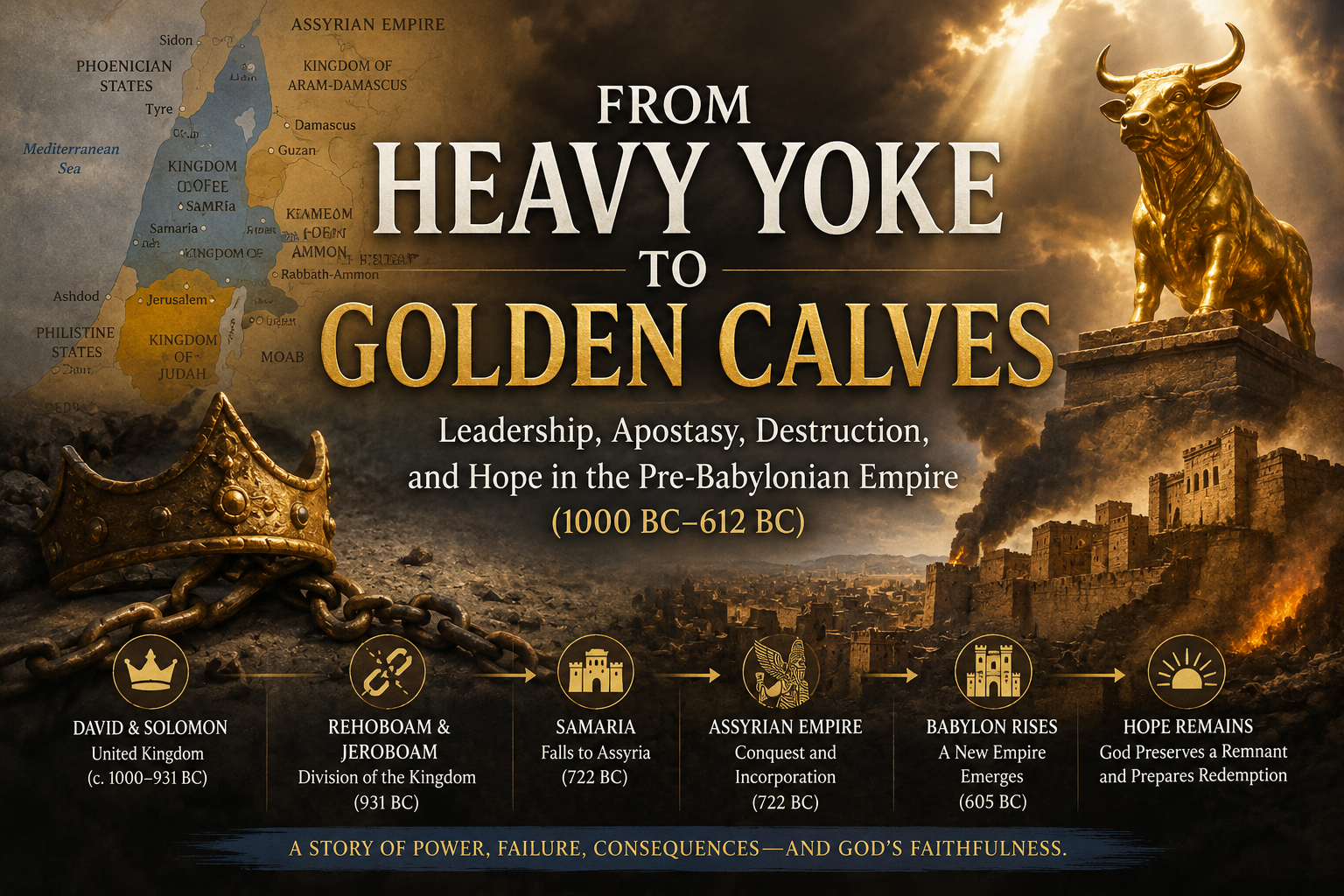
Leadership, Apostasy, Destruction, and Hope in the Pre-Babylonian Empire (1000 BC–612 BC)
By Gerald J. Leonard
The greatest leadership failures rarely begin with collapse.
They begin with compromise.
A kingdom still looks prosperous. Institutions still function. The temple still stands. The economy appears strong. The leaders still speak confidently. Yet beneath the visible success, something foundational has already begun to fracture.
That is the story of Israel during the Pre-Babylonian Empire period.
From the united monarchy of Solomon to the destruction of Samaria by Assyria in 722 BC and the looming fall of Judah before Babylon, the biblical narrative reveals a sobering pattern: nations rarely fall suddenly. They decay internally long before they collapse externally.
This period is not merely ancient political history. It is a leadership case study in covenant failure, organizational drift, oppressive systems, fear-based governance, and the long-term consequences of compromised worship.
And yet, woven through apostasy and judgment is another thread: hope.
The God who judges covenant unfaithfulness also preserves a remnant, raises prophetic voices, and continues preparing redemption in the midst of collapse.
That tension—between destruction and hope—is the heartbeat of 1–2 Kings, the prophets, and the intertestamental story that follows.
The Leadership Crisis Beneath the Prosperity
Transformational communication moves between two realities:
- What is
- What could be
The Pre-Babylonian kingdom narrative lives inside that contrast.
What Was
Israel looked powerful.
Under David and Solomon, the kingdom possessed:
- military strength
- economic expansion
- international influence
- architectural achievement
- centralized administration
- religious prestige
But beneath the appearance of strength, covenant erosion had already begun.
Solomon’s failure was not primarily strategic incompetence. It was a spiritual compromise.
The biblical narrative in 1 Kings 11 presents Solomon’s idolatry as the deep fracture beneath the political surface. His divided heart weakened the covenant foundation of the kingdom long before the kingdom visibly divided.
This is the first major insight from my research and reading the reference books for this study.
The kingdom was spiritually divided before it was politically divided.
That distinction matters enormously for leadership.
Organizations, families, ministries, and nations often appear healthy long after their core values have begun eroding.
Visible success can mask invisible decay.
The Heavy Yoke: When Leadership Becomes Oppression
The fracture becomes visible in 1 Kings 12.
After Solomon’s death, the northern tribes came to Rehoboam with a request:
“Lighten the harsh labor and the heavy yoke your father put on us.”
This moment is pivotal.
The people are not demanding revolution.
They are asking for relief.
That detail changes the entire interpretation of the kingdom’s division.
The research readings correctly identify this as more than political dissatisfaction. The “heavy yoke” language echoes Israel’s memory of bondage in Egypt.
The ESV Global Study Bible insight is especially powerful here:
Israel, once liberated from Pharaoh’s oppression, now feels burdened under its own monarchy.
This becomes a profound leadership warning:
A system originally designed to serve people can slowly become a system that consumes them.
In modern leadership language:
- productivity becomes exploitation
- growth becomes pressure
- scale becomes bureaucracy
- authority becomes coercion
- performance becomes identity
The organization still produces results, but people begin carrying a “heavy yoke.”
And when leaders stop listening to burdened people, rupture becomes inevitable.
Rehoboam and the Failure of Servant Leadership
Rehoboam’s leadership test is one of the clearest executive decision moments in Scripture.
He receives two competing leadership philosophies.
The Elders’ Advice
Serve the people.
Speak kindly.
Earn loyalty through humility.
The Younger Advisers’ Advice
Assert dominance.
Increase pressure.
Rule through intimidation.
Rehoboam chooses intimidation.
Rehoboam completely misreads the audience’s emotional state.
He assumes authority must be protected through severity.
But the people are not primarily testing strength.
They are testing whether the king understands their burden.
That distinction changes everything.
Rehoboam confused strength with severity.
Modern organizations repeat this mistake constantly.
Executives often face uncertainty:
- tighten control
- increase pressure
- reduce empathy
- centralize authority
- overcorrect with intensity
But fear-driven control rarely produces loyalty.
It produces disengagement.
Rehoboam inherited a fragile kingdom and treated fragility like rebellion.
That decision shattered the nation.
Jeroboam: The Tragedy of Fear-Based Leadership
Jeroboam is one of the most psychologically fascinating leaders in Scripture.
He begins with legitimacy.
Ahijah’s prophecy gives him a genuine opportunity to lead the northern tribes under God’s authority.
This matters because Jeroboam is not merely a villain.
He represents a tragic leadership arc:
a leader who receives an opportunity from God but attempts to secure it through fear.
Jeroboam feared losing political control if the people continued worshiping in Jerusalem.
So he created:
- rival worship centers at Bethel and Dan
- golden calves
- unauthorized priests
- alternative festivals
This was politically brilliant.
And spiritually catastrophic.
The ESV Global Study Bible’s Moses/Aaron comparison is extraordinarily insightful here.
Jeroboam first appears almost like a second Moses:
leading people away from oppressive rule.
But he quickly becomes like Aaron:
fashioning golden calves.
That is one of the deepest leadership warnings in Scripture:
A leader can begin as a liberator and become a corrupter.
The Neuroscience of Fear-Driven Leadership
One reason this story feels timeless is that it aligns closely with modern neuroscience.
Under perceived threat, leaders often default into:
- control behaviors
- tribal protection
- short-term thinking
- identity preservation
- reactive decision loops
Jeroboam’s leadership was driven by anticipatory fear:
“If the people return to Jerusalem, I may lose power.”
Fear distorted discernment.
Instead of trusting covenant faithfulness, Jeroboam engineered artificial loyalty.
This is still how many institutions operate today.
Leaders reshape:
- culture
- messaging
- systems
- incentives
- even moral frameworks
not around truth, but around preserving power.
The result is almost always the same:
short-term stability followed by long-term corruption.
The Prophets: Voices Against Institutional Drift
The prophets emerge as covenant auditors.
Amos and Hosea, especially, reveal that Israel’s worship problem became:
- a justice problem
- a moral problem
- a national identity problem
Amos condemns Bethel because false worship ultimately leads to distorted ethics.
Hosea condemns the calf-idol because what Israel created with human hands eventually replaced trust in God.
This is one of the most important insights from the research:
False worship never remains isolated in ritual life.
It eventually reshapes social and moral life.
That principle extends beyond ancient Israel.
Whatever an organization ultimately worships—
profit,
image,
control,
growth,
celebrity,
political dominance—
will eventually shape its ethics.
Worship always drives culture.
Apostasy, Destruction, and Hope
Roger Ellsworth’s framing is profoundly important:
Apostasy leads to destruction, but not without hope.
The northern kingdom eventually falls to Assyria.
2 Kings 17 interprets the collapse theologically:
Israel persisted in “the sins of Jeroboam.”
The destruction was not random.
It was cumulative.
One compromise became a pattern.
The pattern became a culture.
The culture led to national decline.
But the biblical narrative refuses to end with destruction alone.
Even amid judgment:
- prophets still speak
- covenant promises still stand
- David’s line is preserved
- reform movements still emerge
- hope still survives
This becomes especially evident in Judah through leaders such as Hezekiah and Josiah.
The narrative repeatedly alternates between:
- decline and reform
- corruption and renewal
- judgment and mercy
That rhythm matters.
Because the biblical story is not merely documenting a collapse.
It reveals God’s persistent commitment to redemption amid human failure.
“What Could Be”
The powerful narratives of the Pre-Babylonian period create movement by contrasting a broken reality with transformed possibility.
What Is
- covenant compromise
- oppressive leadership
- fear-based religion
- institutional drift
- injustice
- fragmentation
What Could Be
- servant leadership
- covenant faithfulness
- courageous trust
- worship centered on God rather than power
- justice rooted in obedience
- humility before authority
This tension is why the narrative still resonates with modern leaders.
The story is not merely ancient history.
It is diagnostic literature.
The Leadership Framework of the Divided Kingdom
The divided kingdom can be understood through three cascading failures:
1. Solomon Weakened the Foundation
Failure:
Covenant compromise.
Leadership Lesson:
Visible success cannot compensate for spiritual erosion.
Modern Parallel:
Organizations that scale operationally while weakening cultural integrity.
2. Rehoboam Broke Trust
Failure:
Harsh leadership and refusal to listen.
Leadership Lesson:
Pressure without empathy fractures loyalty.
Modern Parallel:
Executives who respond to organizational fatigue with more control rather than service.
3. Jeroboam Corrupted Worship
Failure:
Fear-based institutional control.
Leadership Lesson:
Leaders who manipulate identity and worship to preserve power create long-term decay.
Modern Parallel:
Systems that prioritize brand preservation over truth and integrity.
Executive Reframe: Silence, Collapse, and Preparation
One of the most important connections to your broader Between the Testaments project is this:
The destruction of the kingdoms creates the conditions for future renewal.
What looks like collapse is also preparation.
The exile, prophetic warnings, Assyrian pressure, and eventual Babylonian domination all become part of the larger redemptive story that leads into the intertestamental period and ultimately to Christ.
This aligns with your core platform insight:
Silence is not absence.
It is preparation.
The Pre-Babylonian period teaches that God is often working beneath visible instability:
- exposing false foundations
- refining identity
- preserving covenant memory
- preparing future restoration
The Final Leadership Insight
Israel did not collapse because it lacked talent, infrastructure, or visible strength.
It collapsed because:
- covenant compromise weakened the foundation
- oppressive leadership fractured trust
- fear reshaped worship
- and political preservation replaced covenant faithfulness
The kingdom cracked under Solomon,
broke under Rehoboam,
and decayed under Jeroboam.
Yet even in judgment, hope remained.
Because throughout apostasy and destruction, God was still preparing redemption.
That may be the most enduring leadership lesson of the entire period:
A system can survive temporary weakness,
But it cannot survive indefinitely when leaders sacrifice covenant truth for control.
And yet,
even after collapse,
God still writes restoration into the story.
Scriptures to study:
- 1 Kings 12:1-24 NLT
- 2 Kings 17:24-29 NLT
Books used in research:
- Apostasy, destruction, and hope 2 Kings explained; Roger Ellsworth. 2002. Apostasy, Destruction and Hope: 2 Kings Explained. Welwyn Commentary Series. Darlington, England: Evangelical Press.
- THE COLLEGE PRESS NIV COMMENTARY; 1 & 2 KINGS; JESSE C. LONG, jr. Long, Jesse C. 2002. 1 & 2 Kings. College Press NIV Commentary. Joplin, MO: College Press Pub.
- II Kings: A New Translation with Introduction and Commentary by Mordechai Cogan and HAYIM TADMOR, volume 11. Cogan, Mordechai, and Hayim Tadmor. 2008. II Kings: A New Translation with Introduction and Commentary. Vol. 11. Anchor Yale Bible. New Haven; London: Yale University Press.
- Prophets of Israel; By Marni Shideler McKenzie McKenzie, Marni Shideler. 2004. Prophets of Israel. Dickson, TN: Explorer’s Bible Study.
Comments
One response to “From Heavy Yoke to Golden Calves”
Hi Gerald.
I commend you on your Amazing, spiritually Driven Insights. You are much more than a musician. Thank God for Remnants as History Repeats itself. All that Glitters is not Gold, when I look at my Personal walk with God I see all that you exposed in-this study.I can see more clearly now. More to share on a more personal platform. Fantastic Study.